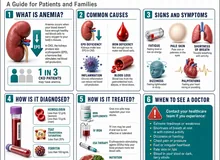
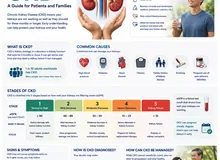
CKD anemia content reviewed November 6, 2026 against KDIGO 2026. Population-specific rules are in the Evidence section below and in the CKD anemia guide.
- Select HD or non-HD/PD and enter TSAT and ferritin.
- Indicate ongoing iron treatment and systemic infection where applicable.
- Review population-specific initiation criteria separately from routine withhold limits. Confirm anemia and the clinical context.
When to use
Use in adults with CKD and anemia when deciding whether to start, continue, or hold iron. Enter TSAT and ferritin from the same draw.
- Tick Already receiving iron to review an ongoing regimen rather than a new start.
- Kidney transplant recipients use the non-dialysis criteria (KDIGO 2026 Appendix Figure 4).
- Not for children; pediatric thresholds differ.
Interpretation and limitations
- Start and withhold thresholds differ. Between them (for example, HD with ferritin 600 ng/mL and TSAT 25%) KDIGO neither suggests starting nor mandates stopping.
- Ferritin is an acute-phase reactant; a high ferritin alone does not diagnose iron overload.
- Systemic infection: consider pausing iron; inflammation without infection needs clinical assessment.
- Dose limits: IV doses should not exceed the maximum single dose for the formulation (KDIGO 2026 practice point 2.9).
- Profound iron deficiency without anemia (ferritin <30 ng/mL and TSAT <20%) may warrant iron, especially with symptoms.
IV Iron Decision — Initiation / Ongoing Review / Withhold (CKD)
Enter the adult CKD setting, TSAT, and ferritin. Indicate ongoing iron treatment and systemic infection. The result supports clinical review of initiation, maintenance, or withholding; it does not select a fixed iron dose.
Source: KDIGO 2026 Anemia in CKD, recommendations 2.1–2.4 and 3.2.1–3.3.1; practice points 2.2–2.8 and 3.4.1.2–3.4.3.5. Reviewed November 6, 2026. Apply clinical judgment and the locally approved product label.
Next steps
- Consider iron: HD — IV iron, proactive and monitored (PIVOTAL-like). Non-dialysis/PD — oral or IV; switch to IV if oral fails after 1–3 months. Size a course with the Ganzoni calculator.
- Review maintenance: weigh Hb and iron trends, blood loss, response, and tolerance; not an automatic instruction to continue.
- Reassess or withhold: investigate persistent anemia; recheck indices before restarting.
- Monitor: Hb, ferritin, and TSAT every 1–3 months in HD and every 3 months otherwise.
Evidence and clinical rules
| Population / decision | KDIGO 2026 guidance |
|---|---|
| Anemia + hemodialysis (HD): initiate iron | Ferritin ≤500 ng/mL and TSAT ≤30%. IV iron is suggested; use a proactive, monitored approach. |
| Anemia + non-dialysis CKD or peritoneal dialysis (PD): initiate iron | Ferritin <100 ng/mL and TSAT <40%, or ferritin ≥100 and <300 ng/mL and TSAT <25%. |
| Route outside HD | Choose oral or IV iron using severity, response, tolerance, preference, availability, and cost. Switch an optimal oral regimen to IV if ineffective after 1–3 months or poorly tolerated. |
| Withhold routine iron | Ferritin >700 ng/mL or TSAT ≥40%. An elevated ferritin alone does not diagnose iron overload. |
| Systemic infection | Consider temporarily suspending iron. Inflammation without infection needs clinical assessment rather than an automatic infection diagnosis. |
| Profound iron deficiency without anemia | Ferritin <30 ng/mL and TSAT <20%: consider oral or IV iron, especially with symptoms (practice point 2.11). |
| Kidney transplant recipients | KDIGO 2026 applies the non-dialysis criteria (Appendix Figure 4). Monitor phosphate after ferric carboxymaltose and similar preparations. |
| Monitoring during iron treatment | Hb, ferritin, TSAT every 3 months in non-dialysis CKD/PD; every 1–3 months in HD, often monthly. Test sooner after blood loss, hospitalization, ESA escalation, or rapidly changing iron indices. |
Source: KDIGO 2026 Anemia in CKD, recommendations 2.1–2.4 and 3.2.1–3.3.1; practice points 2.2–2.8 and 3.4.1.2–3.4.3.5. Reviewed November 6, 2026. Apply clinical judgment and the locally approved product label.