Anemia care in chronic kidney disease (CKD), including hemodialysis (HD) and peritoneal dialysis (PD), reviewed November 6, 2026 against Kidney Disease: Improving Global Outcomes (KDIGO) 2026. Assess the complete blood count (CBC), transferrin saturation (TSAT), and ferritin before individualizing erythropoiesis-stimulating agent (ESA) therapy. See the population-specific KDIGO 2026 rules.
Understanding "EPO-Resistant" anemia of kidney diseasePag-unawa sa "EPO-Resistant" anemia sa sakit sa batoPagsabot sa "EPO-Resistant" anemia sa sakit sa kidneyPamag-intindi king "EPO-Resistant" anemia king sakit king batu
Healthy kidneys make a hormone called erythropoietin (EPO) that tells your bone marrow to build red blood cells. When kidneys are damaged, they make less EPO — so you can become anemic and feel tired, short of breath, cold, or weak. To help, your kidney doctor may prescribe an EPO-like injection (an ESA, or "erythropoiesis-stimulating agent"). For most patients, this works well.Ang malulusog na bato ay gumagawa ng hormon na tinatawag na erythropoietin (EPO) na nag-uutos sa utak ng buto na gumawa ng mga pulang selula ng dugo. Kapag may pinsala ang bato, mas kaunting EPO ang nagagawa — kaya maaari kang magka-anemia at maramdamang pagod, hingal, lamig, o manghina. Para tumulong, maaaring magreseta ang iyong doktor ng EPO-like na iniksyon (isang ESA, o "erythropoiesis-stimulating agent"). Sa karamihan, mahusay itong gumagana.Ang himsog nga kidney naghimo og hormon nga gitawag og erythropoietin (EPO) nga nagsugo sa utok sa bukog nga maghimo og mga pulang selula sa dugo. Kung adunay danyos ang kidney, gamay ra ang EPO nga mahimo — busa mahimo ka magka-anemia ug mobati og kapoy, kapulgi, katugnaw, o kaluya. Aron makatabang, mahimong magreseta ang imong doktor og EPO-like nga iniksyon (usa ka ESA, o "erythropoiesis-stimulating agent"). Sa kadaghanan, maayo kining molihok.Ing malulusog a batu ya gumagawa ning hormon a tinatawag a erythropoietin (EPO) a nag-uutos king utak ning butu a gumawa ning deng pulang selula ning daya. Nung atin pinsala ing batu, mas kaunting EPO ing nagagawa — kaya pwedeng magka-anemia ka at maramdamang pagod, hingal, lamig, o manghina. Para tumulong, pwedeng magreseta ing kekang doktor ning EPO-like a iniksyon (metung a ESA, o "erythropoiesis-stimulating agent"). King karamihan, mahusay itong gumagana.
But sometimes the marrow does not respond — even at higher doses. We call this "EPO resistance" or hyporesponsiveness. The important truth is this: it almost always means something else is getting in the way of making red cells — not that your body has stopped listening to EPO. Finding and fixing that "something else" is far safer and more effective than just pushing the dose higher.Pero minsan, hindi tumutugon ang utak ng buto — kahit tumaas na ang dose. Tinatawag itong "EPO resistance" o hyporesponsiveness. Ang mahalagang katotohanan: halos palaging may ibang bagay na humaharang sa paggawa ng mga pulang selula — hindi na hindi nakikinig ang katawan sa EPO. Mas ligtas at mas epektibong hanapin at ayusin ang "ibang bagay" na iyon kaysa basta itaas ang dose.Apan usahay, dili motubag ang utok sa bukog — bisan misaka na ang dose. Gitawag namo kining "EPO resistance" o hyporesponsiveness. Ang importanting kamatuoran: halos kanunay adunay laing butang nga nagpugong sa paghimo og pulang selula — dili nga wala na maminaw ang lawas sa EPO. Mas luwas ug mas epektibo ang pagpangita ug pag-ayo sa "laing butang" nga kana kaysa basta-basta nga pagsaka sa dose.Pero misan, ali tumutugon ing utak ning butu — kahit tumaas na ing dose. Tinatawag mi ining "EPO resistance" o hyporesponsiveness. Ing mahalagang katotohanan: halos palaging atin aliwa a bagay a humaharang king paggawa ning deng pulang selula — ali a ali na makikinig ing bangkî king EPO. Mas ligtas at mas epektibong hanapin at ayusin ing "aliwa a bagay" a yan kesa basta itaas ing dose.
The key ideaAng susing ideyaAng sentro nga ideyaIng susing ideya
EPO resistance is rarely a failure of the marrow to "hear" the signal. It is almost always a failure of substrate (iron the marrow can actually use) and a hostile inflammatory environment. Fix those, and the marrow usually starts working again — at a much safer EPO dose.Bihirang totoong tumigil sa pakikinig ang utak ng buto. Halos palaging kulang sa materyales (iron na talagang magagamit ng utak ng buto) at may matinding pamamaga sa katawan. Kapag inayos ang mga ito, kadalasang magsisimulang gumana ulit ang utak ng buto — sa mas ligtas na dose ng EPO.Panagsa ra nga tinuod nga mihunong sa pagpaminaw ang utok sa bukog. Halos kanunay kulang sa materyales (iron nga magamit gayud sa utok sa bukog) ug adunay grabe nga pamamaga sa lawas. Kung ayohon kini, kasagaran mosugod og molihok pag-usab ang utok sa bukog — sa mas luwas nga dose sa EPO.Bihirang totoong tumigil king pakikinig ing utak ning butu. Halos palaging kulang king materyales (iron a talagang magagamit ning utak ning butu) at atin matinding pamamaga king bangkî. Nung inayos ing deng ini, kadalasan magsisimulang gumana pasibayu ing utak ning butu — king mas ligtas a dose ning EPO.
The most common reasons EPO stops workingMga karaniwang dahilan kung bakit hindi na umuubra ang EPOMga kasagarang hinungdan nganong dili na molihok ang EPODeng karaniwang dahilan kung bakit ali na umuubra ing EPO
🩸 Low iron — or iron that is "locked away"Mababang iron — o iron na "nakakulong"Ubos nga iron — o iron nga "nakulong"Mababang iron — o iron a "makulong"
The number-one cause. Even when iron stores look normal on a blood test, inflammation can trap iron inside cells so the marrow cannot reach it. This is why IV iron — not just iron pills — is usually needed in dialysis.Pinakanumero unong sanhi. Kahit normal ang itsura ng iron sa blood test, ang pamamaga ay maaaring magkulong sa iron sa loob ng mga selula kaya hindi ito maabot ng utak ng buto. Kaya kailangan ng IV iron sa dialysis — hindi lang iron pills.Numero uno nga hinungdan. Bisan normal ang iron sa blood test, ang pamamaga makapatipig sa iron sulod sa mga selula busa dili kini maabot sa utok sa bukog. Mao nga IV iron ang gikinahanglan sa dialysis — dili lang iron pills.Pinakanumero unong sanhi. Kahit normal ing itsura ning iron king blood test, ing pamamaga ya pwedeng magkulong king iron king lub ning deng selula kaya ali ini maabot ning utak ning butu. Kaya kailangan ning IV iron king dialysis — ali la iron pills.
🔥 Inflammation or hidden infectionPamamaga o nakatagong impeksyonPamamaga o tinago nga impeksyonPamamaga o makatagong impeksyon
Infections you may not feel — a quiet dental abscess, a dialysis catheter, a foot ulcer, a failed graft — release proteins that trap iron and tell the marrow to slow down. Cleaning these up often restores EPO response.Mga impeksyong maaaring hindi mo maramdaman — tahimik na ngipin na abscess, dialysis catheter, sugat sa paa, palpak na graft — ay naglalabas ng mga protina na nagkukulong sa iron at nagpapabagal sa utak ng buto. Kapag nalinis ang mga ito, madalas na nakakabalik ang tugon sa EPO.Mga impeksyon nga mahimo dili nimo bation — hilom nga abscess sa ngipon, dialysis catheter, samad sa tiil, napakyas nga graft — nagpagawas og mga protina nga nagkulong sa iron ug nagsugo sa utok sa bukog nga maghinay. Kung mahinloan kini, kasagaran mobalik ang tubag sa EPO.Deng impeksyong pwedeng ali mu maramdaman — tahimik a ngipin a abscess, dialysis catheter, sugat king bitis, palpak a graft — ya naglalabas ning deng protina a nagkukulong king iron at nagpapabagal king utak ning butu. Nung nalinis ing deng ini, madalas a nakakabalik ing tugon king EPO.
🦴 Overactive parathyroid glandsSobrang aktibong parathyroid glandsSobrang aktibong parathyroid glandsSobrang aktibong parathyroid glands
In advanced kidney disease, the parathyroid glands can become overactive (high PTH on labs). Very high PTH replaces healthy marrow with scar tissue and blunts EPO response. Vitamin D, phosphate binders, calcimimetics, or surgery can help.Sa advanced na sakit sa bato, maaaring maging sobrang aktibo ang parathyroid glands (mataas ang PTH sa labs). Ang napakataas na PTH ay pumapalit sa malusog na utak ng buto ng peklat at nagpapabagal sa tugon sa EPO. Makakatulong ang vitamin D, phosphate binders, calcimimetics, o operasyon.Sa advanced nga sakit sa kidney, mahimong sobrang aktibo ang parathyroid glands (taas ang PTH sa labs). Ang taas kaayong PTH nagpuli sa himsog nga utok sa bukog og scar tissue ug nagpahinay sa tubag sa EPO. Makatabang ang vitamin D, phosphate binders, calcimimetics, o operasyon.King advanced a sakit king batu, pwedeng maging sobrang aktibo ing parathyroid glands (mataas ing PTH king labs). Ing napakataas a PTH ya pumapalit king malusog a utak ning butu ning peklat at nagpapabagal king tugon king EPO. Makakatulong ing vitamin D, phosphate binders, calcimimetics, o operasyon.
🍚 Poor nutrition or weight lossMahinang nutrisyon o pagbaba ng timbangMahinang nutrisyon o paghulog sa timbangMahinang nutrisyon o pagbaba ning timbang
Protein-energy wasting — losing muscle and protein — strongly predicts a poor EPO response. Adequate protein at meals (especially around dialysis), enough calories, and treating the appetite-killing parts of chronic kidney disease (CKD) are foundational.Ang protein-energy wasting — pagkawala ng muscle at protina — ay malakas na nag-aabiso ng mahinang tugon sa EPO. Mahalaga ang sapat na protina sa bawat kain (lalo na sa paligid ng dialysis), sapat na calories, at paggamot sa mga sanhi ng pagkawala ng gana.Ang protein-energy wasting — pagkawala sa kaunuran ug protina — kusgan nga nagpamatuod sa mahinang tubag sa EPO. Importante ang sapat nga protina matag pagkaon (labi na sa palibot sa dialysis), sapat nga calories, ug pagtambal sa mga hinungdan sa pagkawala sa gana.Ing protein-energy wasting — pagkawala ning muscle at protina — ya makapangang nag-aabiso ning mahinang tugon king EPO. Mahalaga ing sapat a protina king bawat kain (lalo na king paligid ning dialysis), sapat a calories, at paggamut king deng sanhi ning pagkawala ning gana.
💧 Not enough dialysisHindi sapat na dialysisDili sapat nga dialysisAli sapat a dialysis
If dialysis is under-prescribed or sessions get cut short, uremic toxins build up. Some of these toxins (like indoxyl sulfate) directly suppress red-cell production and shorten the lifespan of the cells that do get made.Kung kulang ang reseta ng dialysis o pinaiikli ang mga session, naipon ang mga uremic toxin. Ang ilan sa mga ito (tulad ng indoxyl sulfate) ay direktang pumipigil sa paggawa ng pulang selula at pinaikli ang buhay ng mga selulang nagagawa.Kung kulang ang reseta sa dialysis o gipamubo ang mga session, magpundok ang mga uremic toxin. Ang uban niini (sama sa indoxyl sulfate) direkta nga nagpugong sa paghimo og pulang selula ug nagpamubo sa kinabuhi sa mga selula nga nahimo.Nung kulang ing reseta ning dialysis o pinaiikli ing deng session, naipon ing deng uremic toxin. Ing aliwa king deng ini (kapariho ning indoxyl sulfate) ya direktang pumipigil king paggawa ning pulang selula at pinaikli ing biye ning deng selulang nagagawa.
🌿 Low vitamin D, B12, or folateMababang vitamin D, B12, o folateUbos nga vitamin D, B12, o folateMababang vitamin D, B12, o folate
These vitamins are quiet partners for the marrow. Vitamin D also dampens inflammation. Replacing them is cheap, safe, and can meaningfully improve the response to EPO when levels are low.Ang mga bitaminang ito ay tahimik na katuwang ng utak ng buto. Ang vitamin D ay nakakapagpababa rin ng pamamaga. Ang pagpapalit sa mga ito ay mura, ligtas, at maaaring makatulong nang malaki sa tugon sa EPO kapag mababa ang antas.Kining mga bitamina hilom nga kauban sa utok sa bukog. Ang vitamin D nagpaubos usab sa pamamaga. Ang pag-puli niini barato, luwas, ug mahimong makatabang og dako sa tubag sa EPO kung ubos ang lebel.Ing deng bitaminang ini ya tahimik a katuwang ning utak ning butu. Ing vitamin D ya nakakapagpababa mu ning pamamaga. Ing pagpapalit king deng ini ya mura, ligtas, at pwedeng makatulong nang malaki king tugon king EPO nung mababa ing antas.
🩸 Hidden blood lossNakatagong pagkawala ng dugoTinago nga pagkawala sa dugoMakatagong pagkawala ning daya
Slow bleeding from the gut, frequent blood draws, blood left in the dialysis circuit, or heavy periods all drain iron. Stool tests, upper-GI evaluation, or gynecologic review may be needed.Mabagal na pagdurugo sa bituka, madalas na blood draws, dugo na naiwan sa dialysis circuit, o malakas na regla ay nag-aalis ng iron. Maaaring kailanganin ang stool tests, upper-GI evaluation, o gynecologic review.Hinay nga pagdugo sa tinai, kanunay nga blood draws, dugo nga nahabilin sa dialysis circuit, o kusog nga regla nagpaubos sa iron. Mahimong gikinahanglan ang stool tests, upper-GI evaluation, o gynecologic review.Mabagal a pagdurugo king bituka, madalas a blood draws, daya a naiwan king dialysis circuit, o makalat a regla ya nag-aalis ning iron. Pwedeng kailanganin ing stool tests, upper-GI evaluation, o gynecologic review.
⛔ A rare reaction to the EPO itselfMga bihirang reaksyon sa EPO mismoTalagsa nga reaksyon sa EPO mismoBihirang reaksyon king EPO mismo
Very rarely, the body makes antibodies that block EPO completely. This shows up as a sudden fall in hemoglobin with no new red cells being made — and is a medical urgency. Your doctor screens for this when hemoglobin crashes on therapy.Napakabihira, gumagawa ng antibodies ang katawan na ganap na humaharang sa EPO. Ipinapakita ito ng biglaang pagbaba ng hemoglobin na walang bagong pulang selula — isang medikal na agarang sitwasyon. Sinusuri ng doktor mo ito kapag biglaang bumagsak ang hemoglobin sa therapy.Talagsa kaayo, naghimo og antibodies ang lawas nga hingpit nga nagpugong sa EPO. Magpakita kini sa kalit nga paghulog sa hemoglobin nga walay bag-ong pulang selula — usa ka medikal nga emergency. Susihon kini sa imong doktor kung kalit nga mihulog ang hemoglobin sa therapy.Napakabihira, gumagawa ning antibodies ing bangkî a ganap a humaharang king EPO. Ipinapakita ini ning biglaang pagbaba ning hemoglobin a alang bagong pulang selula — metung a medikal a agarang sitwasyon. Sinusuri ning doktor mu ini nung biglaang bumagsak ing hemoglobin king therapy.
What we do — fix the cause, don't just push the doseAng ginagawa namin — ayusin ang sanhi, hindi basta itaas ang doseAng among ginabuhat — ayohon ang hinungdan, dili basta isaka ang doseIng gagawan mi — ayusin ing sanhi, ali basta itaas ing dose
Your kidney team checks why hemoglobin (Hb) is low before changing treatment. Iron tests and symptoms matter together. IV iron is usually preferred in hemodialysis; oral or IV iron can be chosen in non-dialysis CKD and peritoneal dialysis.
For adults taking an erythropoiesis-stimulating agent (ESA/EPO), the Hb goal is individualized and below 11.5 g/dL (115 g/L). More EPO is not a treatment for every cause of fatigue. Do not change your dose yourself.
The team usually withholds routine iron if ferritin is >700 ng/mL or TSAT ≥40%, and considers pausing it during systemic infection. These are treatment-review limits, not tests that prove iron overload.
Sinusuri ng kidney team ang sanhi ng mababang hemoglobin (Hb) bago baguhin ang gamutan. Magkasamang isinasaalang-alang ang iron tests at sintomas. Karaniwang mas pinipili ang IV iron sa hemodialysis; maaaring oral o IV iron sa CKD na hindi naka-dialysis at sa peritoneal dialysis.
Para sa adult na gumagamit ng erythropoiesis-stimulating agent (ESA/EPO), ang layunin sa Hb ay indibidwal at mas mababa sa 11.5 g/dL (115 g/L). Hindi dagdag na EPO ang lunas sa lahat ng sanhi ng pagod. Huwag baguhin ang dosis nang sarili lamang.
Karaniwang ipinagpapaliban ang regular na iron kung ferritin >700 ng/mL o TSAT ≥40%; maaaring pansamantalang ihinto ito habang may systemic infection. Hindi sapat ang mga numerong ito upang patunayang may iron overload.
Susihon sa kidney team ang hinungdan sa ubos nga hemoglobin (Hb) sa dili pa usbon ang tambal. Tan-awon ang iron tests uban sa mga sintomas. Kasagarang mas pilion ang IV iron sa hemodialysis; mahimong oral o IV iron sa CKD nga wala mag-dialysis ug sa peritoneal dialysis.
Sa hamtong nga naggamit og erythropoiesis-stimulating agent (ESA/EPO), ang tumong sa Hb ipahaom sa pasyente ug ubos sa 11.5 g/dL (115 g/L). Dili dugang EPO ang tubag sa tanang hinungdan sa kakapoy. Ayaw usba ang dosis sa imong kaugalingon.
Kasagarang dili ihatag ang regular nga iron kon ferritin >700 ng/mL o TSAT ≥40%; mahimong ihunong kini sa makadiyot panahon sa systemic infection. Kini nga mga numero dili igo nga pamatuod sa iron overload.
Suriin na ning kidney team ing sangkan ning mababang hemoglobin (Hb) bayu baguan ing gamutan. Lawan la deng iron tests kayabe deng sintomas. Karaniwang mas pipilinan ing IV iron king hemodialysis; malyaring oral o IV iron king CKD a e pa maki-dialysis at king peritoneal dialysis.
Para king adult a gagamit erythropoiesis-stimulating agent (ESA/EPO), ing layunin king Hb ya me-personalize at mas mababa king 11.5 g/dL (115 g/L). Ali dagdag a EPO ing lunas king anggang sangkan ning kapagalan. E mu baguan ing dosis nang sarili mu.
Karaniwang ipagpaliban ing regular a iron nung ferritin >700 ng/mL o TSAT ≥40%; malyari yang pansamantalang itigil kabang atin systemic infection. E sapat deng numerung ini para patunayan ing iron overload.
What you can do to help your treatment workPaano mo matutulungan ang iyong gamutan na umubraUnsaon nimo pagtabang sa imong pagtambal nga molihokPaano mu matutulungan ing kekang gamutan na umubra
Five practical thingsLimang praktikal na bagayLima ka praktikal nga butangLimang praktikal a bagay
1. Take iron and other supplements exactly as prescribed, and keep your lab appointments — your iron and inflammation are tracked by blood tests.
2. Tell us about any signs of infection (fever, redness or pus at your access site, dental pain, foot wounds), bleeding (black or red stools, heavy periods, nosebleeds), or new fatigue.
3. Complete your full dialysis sessions — even when you feel tired or have somewhere to be — and follow your nutrition plan with enough protein.
4. Ask before starting any new supplement, herbal product, or "energy" drink — many of them quietly interfere with iron, EPO, or your kidneys.
5. Bring this guide and your questions to your next visit. Our goal is a steady, safe hemoglobin — not a "perfect" lab number. Feeling better and staying safe matter more than the value alone.1. Inumin ang iron at iba pang supplements ayon sa reseta, at huwag laktawan ang mga lab appointments — sinusubaybayan ang iyong iron at pamamaga sa pamamagitan ng blood tests.
2. Sabihin sa amin ang anumang tanda ng impeksyon (lagnat, pamumula o nana sa access site, sakit ng ngipin, sugat sa paa), pagdurugo (itim o pulang dumi, malakas na regla, balinguyngoy), o bagong pagod.
3. Tapusin ang buong dialysis session — kahit pagod o may pupuntahan — at sundin ang nutrisyon na may sapat na protina.
4. Magtanong bago magsimula ng anumang bagong supplement, herbal product, o "energy" drink — marami sa mga ito ang tahimik na humahadlang sa iron, EPO, o sa iyong bato.
5. Dalhin ang gabay na ito at ang iyong mga tanong sa susunod na bisita. Ang aming layunin ay matatag at ligtas na hemoglobin — hindi "perpektong" numero sa lab. Ang pakiramdam at kaligtasan ay mas mahalaga kaysa sa numero lamang.1. Inuma ang iron ug uban pang supplements sumala sa reseta, ug ayaw laktawi ang mga lab appointments — gisubay ang imong iron ug pamamaga pinaagi sa blood tests.
2. Isulti kanamo ang bisan unsang timailhan sa impeksyon (hilanat, pagpula o nana sa access site, sakit sa ngipon, samad sa tiil), pagdugo (itom o pulang lubay, kusog nga regla, pagdugo sa ilong), o bag-ong kapoy.
3. Humanon ang tibuok dialysis session — bisan kapoy ka o adunay laing buhaton — ug sundon ang nutrisyon nga adunay sapat nga protina.
4. Pangutana sa wala pa magsugod og bisan unsang bag-ong supplement, herbal product, o "energy" drink — daghan niini ang hilom nga nagpugong sa iron, EPO, o sa imong kidney.
5. Dad-a kining giya ug ang imong mga pangutana sa sunod nga bisita. Ang among tumong mao ang malig-on ug luwas nga hemoglobin — dili "perpektong" numero sa lab. Ang pamati ug kaluwasan mas importante kaysa sa numero lamang.1. Inumin ing iron at aliwa pang supplements ayon king reseta, at e laktawan ing deng lab appointments — sinusubaybayan ing kekang iron at pamamaga king pamamagitan ning blood tests.
2. Sabihin kekami ing anumang tanda ning impeksyon (lagnat, pamumula o nana king access site, sakit ning ngipin, sugat king bitis), pagdurugo (itim o pulang dumi, makalat a regla, balinguyngoy), o bagong pagod.
3. Tapusin ing buong dialysis session — kahit pagod o atin pupuntahan — at sundin ing nutrisyon a atin sapat a protina.
4. Magtanong bayu magsimula ning anumang bagong supplement, herbal product, o "energy" drink — dacal king deng ini ya tahimik a humahadlang king iron, EPO, o king kekang batu.
5. Dalhin ing gabay a ini at ing kekang deng tanong king susunod a bisita. Ing kekami layunin ya matatag at ligtas a hemoglobin — ali "perpektong" numero king lab. Ing pakiramdam at kaligtasan ya mas mahalaga kesa king numero lamang.
Warning signs — when to call your kidney teamMga babala — kailan tatawag sa kidney teamMga pasidaan — kanus-a motawag sa kidney teamDeng babala — kailan tatawag king kidney team

A fridge-friendly safety card listing the six warning signs to call about right away — sudden energy drop or paleness, bleeding from the stomach or bowel, very heavy menstrual bleeding, fever or pus at the dialysis access, severe dental pain or a foot wound, and chest pain or stroke signs. Call your dialysis unit or go to the ER — don't wait for your next clinic visit.
Call promptly if any of these appearTumawag agad kung lumitaw ang alinman sa mga itoTawag dayon kung mogawas ang bisan unsa niiniTumawag agad nung lumitaw ing alinman king deng ini
A sudden, severe drop in energy or paleness after weeks of stable injections; black, tarry, or bloody stools, vomiting blood, or sudden very heavy menstrual bleeding; fever, chills, redness, or pus at a dialysis catheter or fistula; severe dental pain, foot wound, or new abscess; chest pain, sudden one-sided weakness, slurred speech, or vision loss (possible stroke). With any of these, contact your dialysis unit or go to the emergency room — do not wait for your next clinic visit.Biglaang at malubhang pagbaba ng lakas o pamumutla pagkatapos ng linggo ng matatag na iniksyon; itim, parang tar, o madugong dumi, pagsusuka ng dugo, o biglaang napakalakas na regla; lagnat, panginginig, pamumula, o nana sa dialysis catheter o fistula; matinding sakit ng ngipin, sugat sa paa, o bagong abscess; sakit ng dibdib, biglaang panghihina sa isang gilid, hindi malinaw na pagsasalita, o pagkawala ng paningin (posibleng stroke). Sa alinman sa mga ito, tumawag sa dialysis unit o pumunta sa emergency room — huwag maghintay sa susunod na bisita.Kalit ug grabe nga paghulog sa kusog o pagpula human sa mga semana sa malig-on nga iniksyon; itom, parang tar, o dugoon nga lubay, pagsuka og dugo, o kalit kaayong kusog nga regla; hilanat, kurog, pagpula, o nana sa dialysis catheter o fistula; grabe nga sakit sa ngipon, samad sa tiil, o bag-ong abscess; sakit sa dughan, kalit nga kahuyang sa usa ka kilid, dili klaro nga pagsulti, o pagkawala sa panan-aw (posible nga stroke). Sa bisan unsa niini, tawag sa dialysis unit o adto sa emergency room — ayaw paghulat sa sunod nga bisita.Biglaang at malubhang pagbaba ning lakas o pamumutla kaybat ning linggo ning matatag a iniksyon; itim, parang tar, o madugong dumi, pagsusuka ning daya, o biglaang napakalakas a regla; lagnat, panginginig, pamumula, o nana king dialysis catheter o fistula; matinding sakit ning ngipin, sugat king bitis, o bagong abscess; sakit ning dibdib, biglaang panghihina king metung a gilid, ali malinaw a pagsasalita, o pagkawala ning paningin (posibleng stroke). King alinman king deng ini, tumawag king dialysis unit o pumunta king emergency room — e maghintay king susunod a bisita.
This guide is general patient education and is not a substitute for personal medical advice. Your treatment plan is tailored to you — please ask Dr. Rivero about your specific situation.Ang gabay na ito ay pangkalahatang edukasyon at hindi kapalit ng personal na payo sa medikal. Ang iyong plano ng paggamot ay nakatutok sa iyo — itanong kay Dr. Rivero ang iyong partikular na sitwasyon.Kining giya kay kinatibuk-ang edukasyon ug dili kapuli sa personal nga tambag sa medisina. Ang imong plano sa pagtambal naka-angkla kanimo — pangutana kang Dr. Rivero bahin sa imong partikular nga sitwasyon.Ing gabay a ini ya pangkalahatang edukasyon at ali kapalit ning personal a payu king medikal. Ing kekang plano ning paggamut ya nakatutok keka — itanong kang Dr. Rivero ing kekang partikular a sitwasyon.
What "ESA hyporesponsiveness" actually means
Investigate iron deficiency or iron-restricted erythropoiesis, inflammation/infection, bleeding, hemolysis, nutritional deficiency, hyperparathyroidism, inadequate dialysis, adherence, and marrow disease before escalating an erythropoiesis-stimulating agent (ESA). A sudden Hb decline with severe reticulocytopenia raises concern for pure red cell aplasia and requires specialist evaluation.
The ESA resistance index (ERI) is weekly epoetin dose ÷ weight ÷ Hb in g/dL. It is a longitudinal exposure/response measure, not a stand-alone diagnosis or instruction to maintain a dose. KDIGO 2026 Table 10 summarizes heterogeneous definitions; ERI 10 is not a universal KDIGO cutoff. Darbepoetin-to-epoetin conversions are approximate and dose-dependent; do not apply a fixed 200-IU/µg factor to CERA as a validated conversion.
Source: KDIGO 2026 Anemia in CKD, recommendations 2.1–2.4 and 3.2.1–3.3.1; practice points 2.2–2.8 and 3.4.1.2–3.4.3.5. Reviewed November 6, 2026. Apply clinical judgment and the locally approved product label.
Hyporesponsiveness is not a benign laboratory curiosity
It is a potent, independent marker of adverse outcomes — and the high ESA doses used to chase it are themselves a hazard.
- Prevalence — definition-dependent, 5–48% in one large cohort; ~12–20% of maintenance-dialysis patients met prespecified hyporesponse definitions in ASCEND-D (Atzinger 2024; McCausland 2025).
- Mortality — in the USRDS Medicare cohort, hyporesponders received ~3.8-fold higher ESA doses, had iron deficiency in 26.5% vs 10.9%, and had 1-year mortality 25.3% vs 22.6% with more cardiovascular hospitalization (Cizman 2020, PMID 33089137).
- Independent risk — log-transformed pre-dialysis ERI independently predicted all-cause death (HR 2.25, 95% CI 1.25–4.06) in incident hemodialysis (Hayashi 2019, PMID 30943479).
- MACE — in ASCEND-D, all three hyporesponse definitions independently predicted adjudicated MACE (adjusted HR 1.32–1.36) with no effect modification by treatment arm. "Baseline ESA hyporesponsiveness is a potent predictor of MACE" (McCausland 2025).
- Renal progression — in non-dialysis CKD, hyporesponsiveness tracks with faster progression to kidney failure and cardiovascular events (Icardi 2013, PMID 23468534; Kato/BRIGHTEN 2017, PMID 28660446).
A mechanism-first map: substrate & milieu, not the signal
Anemia of CKD has two engines — relative EPO deficiency (the failing kidney under-produces erythropoietin) and iron-restricted erythropoiesis under hepcidin control. Resistance to exogenous ESA is overwhelmingly a problem of the second engine plus a suppressive milieu, not of EPO signaling per se (Babitt & Lin 2012, PMID 22935483; Weir 2021, PMID 34280923).
The hepcidin–ferroportin axis — the central lesion

The IL-6 → hepcidin → ferroportin axis is the central lesion of ESA hyporesponsiveness. Inflammation drives hepatic hepcidin; hepcidin internalizes ferroportin on macrophages and enterocytes; iron is trapped intracellularly; the marrow is iron-starved despite normal-to-high ferritin. Intervention targets inflammation, proactive IV iron, HIF-PHIs (lower hepcidin, raise transferrin/TIBC), and emerging anti-IL-6 (ziltivekimab).
- FPN
- ferroportin
- HAMP
- hepcidin antimicrobial peptide gene
- HIF-PHI
- hypoxia-inducible factor prolyl hydroxylase inhibitor
- TIBC
- total iron-binding capacity
Pro-inflammatory cytokines — IL-6 chief among them — drive hepatic hepcidin synthesis. Hepcidin binds and degrades ferroportin, the sole cellular iron-export channel, trapping iron inside enterocytes and macrophages. The result is functional (iron-restricted) erythropoiesis: ferritin is normal or high, yet iron cannot reach the marrow. Inflammation simultaneously suppresses erythroid progenitor proliferation and blunts the hypoxia response — a triple hit on the erythron (Weir 2021; Icardi 2013).
Drivers, mechanisms, and the evidence behind each
| Driver | Mechanism | Key evidence |
|---|---|---|
| Iron deficiency (absolute & functional) | Most common cause. Absolute depletion of stores or hepcidin-mediated sequestration despite adequate stores — limits substrate for hemoglobinization. | Tanaka 2015, PMID 26381391 |
| Inflammation (IL-6, CRP) | Drives hepcidin; suppresses progenitors; impairs hypoxia sensing. The dominant driver of true resistance. | Weir 2021; Babitt 2012 |
| CKD-MBD (chronic kidney disease–mineral and bone disorder) / secondary hyperparathyroidism | PTH as uremic toxin; marrow fibrosis (osteitis fibrosa); FGF23 (fibroblast growth factor 23) implicated. PTH >800 pg/mL over-represented in hyporesponders. | Tanaka 2018, PMID 29767854; Cizman 2020 |
| Uremic toxins (indoxyl sulfate) | Suppresses EPO transcription via the HIF pathway, disrupts iron metabolism, shortens RBC (red blood cell) survival, amplifies oxidative stress — a self-reinforcing cycle. | Rattanasompattikul 2025, PMID 41355384 |
| Malnutrition / PEW (protein-energy wasting) | Protein-energy wasting independently predicts poor EPO response; only non-PEW patients achieved Hb gains. Low albumin tracks the highest ERI tertile. | González-Ortiz 2019, PMID 31412807 |
| Vitamin deficiency (D, B12, folate, C) | Vitamin D deficiency promotes ESA resistance via inflammation; repletion lowered ERI, CRP, ferritin, iPTH. B12/folate needed for erythropoiesis; vitamin C aids iron mobilization. | Icardi 2013; Nand 2017, PMID 28457030 |
| Blood loss / shortened RBC survival | Dialysis-circuit and GI losses, platelet dysfunction, RBC fragmentation, uremic hemolysis — ongoing iron drain and lower Hb yield. | Gembillo 2025, PMID 41024950 |
| Anti-EPO antibody PRCA | Rare but serious — neutralizing antibodies cause pure red cell aplasia. Sudden Hb fall with reticulocytopenia on ESA. Stop ESA immediately. | Hashimoto 2016, PMID 27338269; Wu 2020, PMID 32856389 |
| Carnitine deficiency | Dialysis-related depletion; L-carnitine reduced ERI (MD −2.72) in meta-analysis and cut ERI 25% vs 3% (placebo) in a dedicated RCT (randomized controlled trial) of ESA-hyporesponsive HD (hemodialysis) patients. | Zhu 2021, PMID 33713287; Reuter 2026, J Ren Nutr |
| Other | Malignancy, occult infection, hemoglobinopathy/hemolysis, recent COVID-19 (months-long hepcidin-driven resistance), androgen deficiency. | Gembillo 2025; Dasgupta 2025, PMID 41136869 |
On ACE inhibitors / ARBs
Frequently cited as a cause, but the largest cross-sectional study (515 HD patients) found no association between ACEi (angiotensin-converting enzyme inhibitor) or ARB (angiotensin receptor blocker) use and ESA resistance. Do not reflexively stop renin-angiotensin blockade — the cardiorenal benefit almost always outweighs a theoretical erythropoietic cost (Saudan 2006, PMID 16523432).

A simple five-organ sigil summarizes the multi-organ inflammatory iron-restricted phenotype that drives ESA hyporesponse — not a single-axis EPO failure. Kidney supplies less EPO and more indoxyl sulfate; liver drives hepcidin under IL-6; gut absorption and macrophage iron egress collapse; the marrow erythron is iron-starved and progenitor-suppressed; parathyroid contributes marrow fibrosis. Therapy must address the milieu, not just the signal.
- SHPT
- secondary hyperparathyroidism
- HIF
- hypoxia-inducible factor
A cause-directed algorithm — find the lesion before climbing the dose
Start with a complete blood count (CBC), reticulocyte count, ferritin, and transferrin saturation (TSAT). Adult anemia is Hb <13 g/dL in men or <12 g/dL in women; pediatric thresholds are age-specific. Kidney disease does not exclude another cause.
If the initial tests do not explain anemia, tailor further testing: smear, haptoglobin/lactate dehydrogenase, C-reactive protein, B12/folate, liver tests, thyroid-stimulating hormone, parathyroid hormone, and monoclonal-protein studies. Assess blood loss and nutrition. Ferritin <45 ng/mL, or unexplained microcytosis without a ferritin result or known genetic cause, warrants evaluation for bleeding and appropriate referral (practice points 1.2.1–1.2.3, S19–20).
Investigate iron deficiency or iron-restricted erythropoiesis, inflammation/infection, bleeding, hemolysis, nutritional deficiency, hyperparathyroidism, inadequate dialysis, adherence, and marrow disease before escalating an erythropoiesis-stimulating agent (ESA). A sudden Hb decline with severe reticulocytopenia raises concern for pure red cell aplasia and requires specialist evaluation.
The ESA resistance index (ERI) is weekly epoetin dose ÷ weight ÷ Hb in g/dL. It is a longitudinal exposure/response measure, not a stand-alone diagnosis or instruction to maintain a dose. KDIGO 2026 Table 10 summarizes heterogeneous definitions; ERI 10 is not a universal KDIGO cutoff. Darbepoetin-to-epoetin conversions are approximate and dose-dependent; do not apply a fixed 200-IU/µg factor to CERA as a validated conversion.
Source: KDIGO 2026 Anemia in CKD, recommendations 2.1–2.4 and 3.2.1–3.3.1; practice points 2.2–2.8 and 3.4.1.2–3.4.3.5. Reviewed November 6, 2026. Apply clinical judgment and the locally approved product label.
Why we do not chase normal hemoglobin
| Decision | KDIGO 2026 guidance |
|---|---|
| Adult HD or PD: consider initiation | After reversible causes are addressed, consider ESA when Hb is ≤9–10 g/dL. Select the threshold within that range using symptoms, risks, and patient preferences. |
| Non-dialysis CKD, including transplant recipients | Individualize initiation using symptoms, potential benefit, transfusion avoidance, ESA risks, and preferences; Hb <10 alone is not an automatic start order. |
| Adult maintenance goal | Target Hb below 11.5 g/dL (115 g/L), individualized. A common working range is about 10 to <11.5 g/dL; this is not an anemia diagnostic range. |
| Dose changes | Use the lowest effective dose. Generally avoid adjustments more often than every 4 weeks. If Hb rises >1 g/dL in 2–4 weeks, reduce by 25–50%. Prefer reduction to holding while Hb does not exceed 11.5, as clinically appropriate. |
| Monitoring | Hb every 2–4 weeks after initiation or adjustment; at least every 3 months during maintenance, usually more often in HD. |
| Stroke, thrombosis, and cancer | Consider suspending ESA during hospitalization for acute stroke, vascular access thrombosis, or thromboembolism. Active or previous cancer calls for shared decision-making, especially when treatment aims at cure. Uncontrolled hypertension and product-specific contraindications require review. |
Source: KDIGO 2026 Anemia in CKD, recommendations 2.1–2.4 and 3.2.1–3.3.1; practice points 2.2–2.8 and 3.4.1.2–3.4.3.5. Reviewed November 6, 2026. Apply clinical judgment and the locally approved product label.
Sequencing therapy in the resistant patient
| Population / decision | KDIGO 2026 guidance |
|---|---|
| Anemia + hemodialysis (HD): initiate iron | Ferritin ≤500 ng/mL and TSAT ≤30%. IV iron is suggested; use a proactive, monitored approach. |
| Anemia + non-dialysis CKD or peritoneal dialysis (PD): initiate iron | Ferritin <100 ng/mL and TSAT <40%, or ferritin ≥100 and <300 ng/mL and TSAT <25%. |
| Route outside HD | Choose oral or IV iron using severity, response, tolerance, preference, availability, and cost. Switch an optimal oral regimen to IV if ineffective after 1–3 months or poorly tolerated. |
| Withhold routine iron | Ferritin >700 ng/mL or TSAT ≥40%. An elevated ferritin alone does not diagnose iron overload. |
| Systemic infection | Consider temporarily suspending iron. Inflammation without infection needs clinical assessment rather than an automatic infection diagnosis. |
| Monitoring during iron treatment | Hb, ferritin, TSAT every 3 months in non-dialysis CKD/PD; every 1–3 months in HD, often monthly. Test sooner after blood loss, hospitalization, ESA escalation, or rapidly changing iron indices. |
| Decision | KDIGO 2026 guidance |
|---|---|
| Adult HD or PD: consider initiation | After reversible causes are addressed, consider ESA when Hb is ≤9–10 g/dL. Select the threshold within that range using symptoms, risks, and patient preferences. |
| Non-dialysis CKD, including transplant recipients | Individualize initiation using symptoms, potential benefit, transfusion avoidance, ESA risks, and preferences; Hb <10 alone is not an automatic start order. |
| Adult maintenance goal | Target Hb below 11.5 g/dL (115 g/L), individualized. A common working range is about 10 to <11.5 g/dL; this is not an anemia diagnostic range. |
| Dose changes | Use the lowest effective dose. Generally avoid adjustments more often than every 4 weeks. If Hb rises >1 g/dL in 2–4 weeks, reduce by 25–50%. Prefer reduction to holding while Hb does not exceed 11.5, as clinically appropriate. |
| Monitoring | Hb every 2–4 weeks after initiation or adjustment; at least every 3 months during maintenance, usually more often in HD. |
| Stroke, thrombosis, and cancer | Consider suspending ESA during hospitalization for acute stroke, vascular access thrombosis, or thromboembolism. Active or previous cancer calls for shared decision-making, especially when treatment aims at cure. Uncontrolled hypertension and product-specific contraindications require review. |
After correcting reversible causes, an ESA is generally suggested before a hypoxia-inducible factor prolyl hydroxylase inhibitor (HIF-PHI). A selected patient with ESA hyporesponsiveness may consider a HIF-PHI trial to relieve symptoms or avoid transfusion, with explicit discussion that evidence for clinical benefit and safety in this group is limited.
- Do not combine an ESA and a HIF-PHI.
- Review active malignancy, recent cardiovascular or thrombotic events, and the agent’s local authorization and contraindications.
- Use the lowest effective dose and monitor Hb every 2–4 weeks after initiation or changes.
- Discontinue a trial for hyporesponsiveness after 3–4 months without the desired erythropoietic response.
Correct documented nutritional deficiencies and manage CKD mineral/bone disease for their indications. Vitamin D or L-carnitine should not be presented as proven routine KDIGO anemia therapy; adjunct studies do not establish patient-important benefit for every hyporesponder.
Source: KDIGO 2026 Anemia in CKD, recommendations 2.1–2.4 and 3.2.1–3.3.1; practice points 2.2–2.8 and 3.4.1.2–3.4.3.5. Reviewed November 6, 2026. Apply clinical judgment and the locally approved product label.
At a glance — pattern recognition for the resistant patient
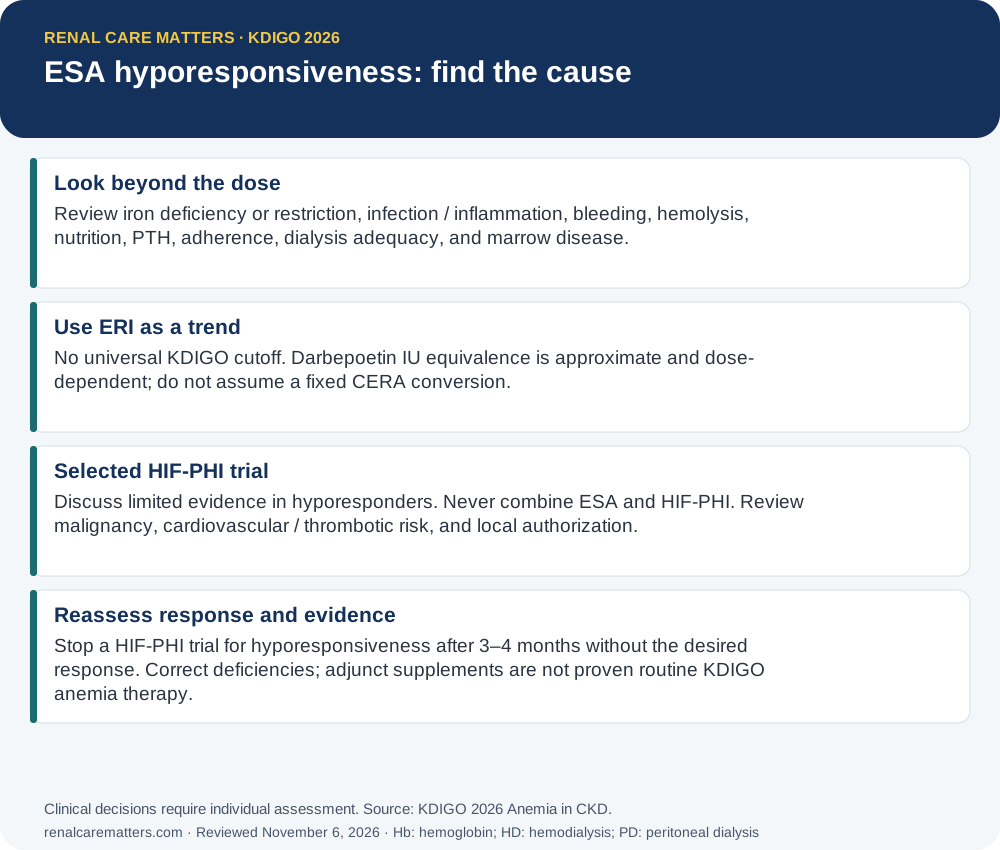
Investigate iron deficiency or iron-restricted erythropoiesis, inflammation/infection, bleeding, hemolysis, nutritional deficiency, hyperparathyroidism, inadequate dialysis, adherence, and marrow disease before escalating an erythropoiesis-stimulating agent (ESA). A sudden Hb decline with severe reticulocytopenia raises concern for pure red cell aplasia and requires specialist evaluation.
The ESA resistance index (ERI) is weekly epoetin dose ÷ weight ÷ Hb in g/dL. It is a longitudinal exposure/response measure, not a stand-alone diagnosis or instruction to maintain a dose. KDIGO 2026 Table 10 summarizes heterogeneous definitions; ERI 10 is not a universal KDIGO cutoff. Darbepoetin-to-epoetin conversions are approximate and dose-dependent; do not apply a fixed 200-IU/µg factor to CERA as a validated conversion.
After correcting reversible causes, an ESA is generally suggested before a hypoxia-inducible factor prolyl hydroxylase inhibitor (HIF-PHI). A selected patient with ESA hyporesponsiveness may consider a HIF-PHI trial to relieve symptoms or avoid transfusion, with explicit discussion that evidence for clinical benefit and safety in this group is limited.
- Do not combine an ESA and a HIF-PHI.
- Review active malignancy, recent cardiovascular or thrombotic events, and the agent’s local authorization and contraindications.
- Use the lowest effective dose and monitor Hb every 2–4 weeks after initiation or changes.
- Discontinue a trial for hyporesponsiveness after 3–4 months without the desired erythropoietic response.
Correct documented nutritional deficiencies and manage CKD mineral/bone disease for their indications. Vitamin D or L-carnitine should not be presented as proven routine KDIGO anemia therapy; adjunct studies do not establish patient-important benefit for every hyporesponder.
Source: KDIGO 2026 Anemia in CKD, recommendations 2.1–2.4 and 3.2.1–3.3.1; practice points 2.2–2.8 and 3.4.1.2–3.4.3.5. Reviewed November 6, 2026. Apply clinical judgment and the locally approved product label.